

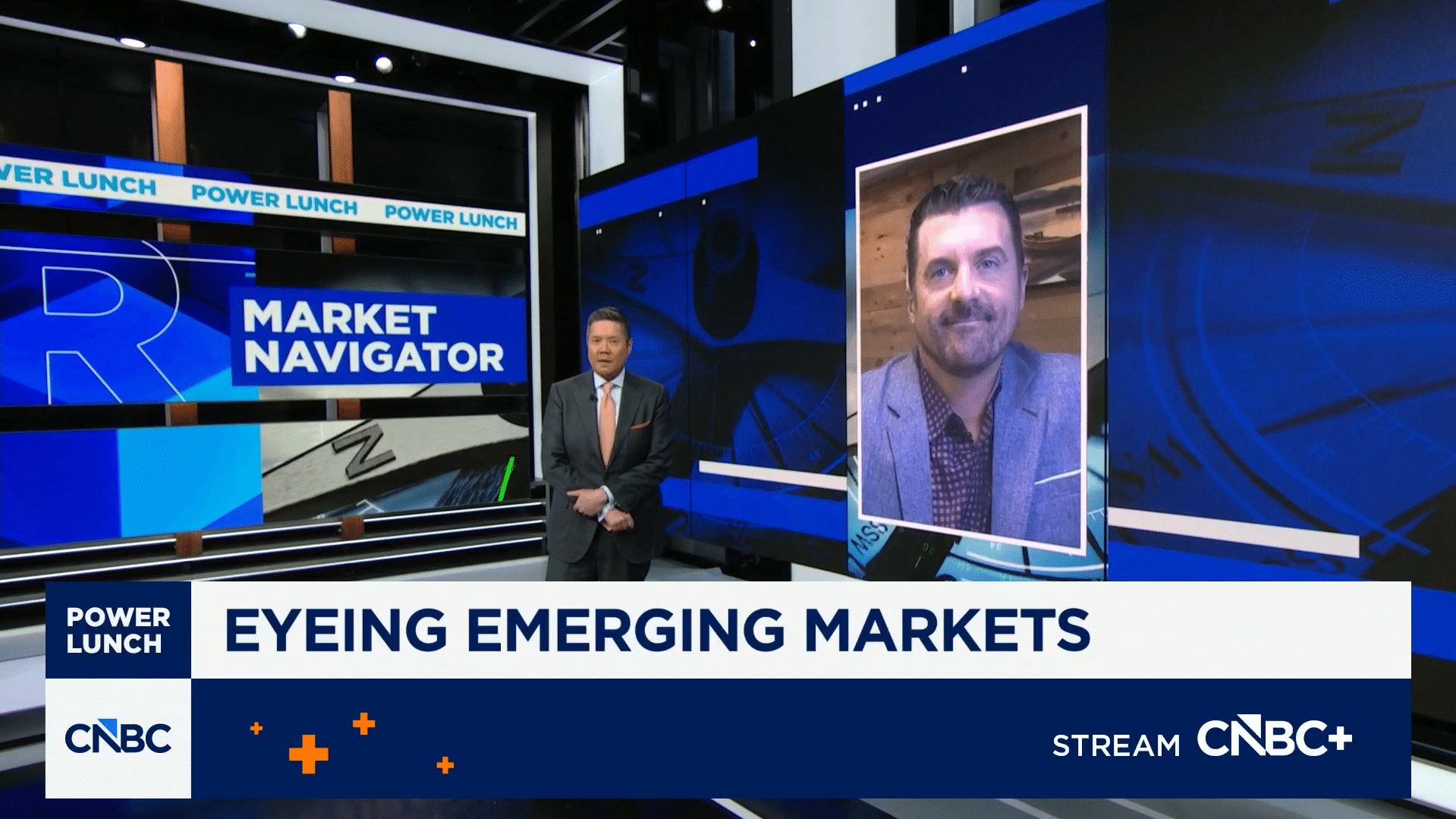
U.S. stocks have dominated global markets for more than a decade, led in recent years by technology, semiconductors, and the AI trade. But Todd Gordon, Founder of Inside Edge Capital and CNBC contributor, joined CNBC’s Power Lunch to explain why investors may want to take another look at emerging markets – and South Korea in particular.
A Potential Rotation Toward Emerging Markets
Todd’s starting point was relative performance.
When emerging markets are compared directly against the S&P 500, U.S. stocks have clearly been the stronger performer for roughly the last 16 years. However, Todd pointed out that this long-running trend may be starting to shift.
A simple relative strength chart suggests that emerging markets may be beginning to reverse higher versus U.S. equities. For investors who have been heavily focused on U.S. tech leadership, that kind of rotation is worth paying attention to:

Why Asia Matters in Emerging Markets
Emerging markets are not just a broad international category. They are heavily weighted toward Asia, with large exposure to markets such as Taiwan, China, and South Korea.
That matters because many of these markets are tied directly to the global technology supply chain. In South Korea’s case, Todd highlighted the country’s role in one of the most important parts of the AI buildout: memory, bandwidth, and high-performance semiconductor components.
South Korea’s Role in the AI Trade
Much of the AI conversation has centered on a handful of U.S. mega-cap technology stocks. But Todd emphasized that the AI trade is not necessarily a winner-take-all story.
As AI demand continues to grow, the infrastructure behind it becomes increasingly important. High-bandwidth memory, DRAM, and related semiconductor components are critical to supporting AI computing needs.
South Korea sits directly in that supply chain. Companies such as Samsung and SK Hynix are major players in memory production, making the country an important part of the broader AI investment theme.
How Investors Can Gain Exposure
Direct access to South Korean equities can be challenging for many U.S. investors. That is where ETFs may offer a more practical solution.
Todd highlighted the Roundhill DRAM ETF as one way to gain exposure to this theme. The fund has significant exposure to South Korean semiconductor and memory companies, including large allocations to Samsung and SK Hynix.
In Todd’s view, that gives investors a way to participate in a part of the AI trade that may be less obvious than the U.S. chip leaders, but still highly important to the overall buildout.
A Stronger Macro Backdrop
Todd also pointed to several broader tailwinds for South Korea.
Earnings expectations have been revised sharply higher this year, the Bank of Korea has remained relatively accommodative, the weaker U.S. dollar has helped support international markets, and South Korea continues to benefit from a strong current account surplus.
Together, these factors have helped create growing interest in South Korean equities.
The Inside Edge Capital Takeaway
The main takeaway from Todd’s CNBC appearance is that investors may not need to look only at U.S. technology stocks to find opportunities tied to AI.
South Korea offers a compelling combination of emerging markets exposure, semiconductor leadership, and participation in the AI infrastructure buildout. As relative strength begins to shift, Todd believes this is an area of the market worth watching closely – and one Inside Edge Capital is evaluating for client portfolios.